What to Eat in Korea: First Dishes and Restaurant Basics
What to eat in Korea on your first trip: dishes that aren't spicy, how to read English menus, the table bell, free side dishes, no tipping, solo dining and allergies.
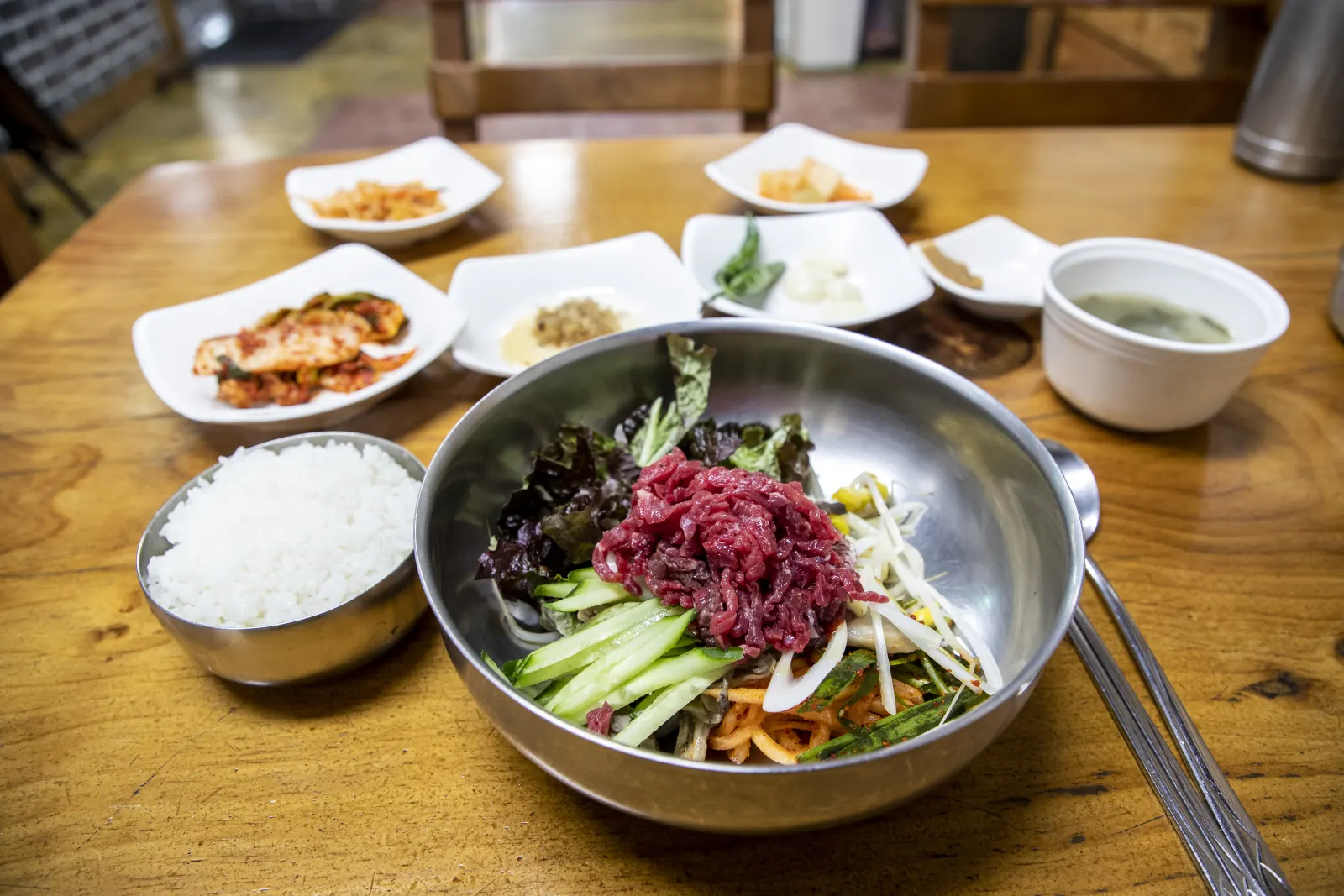
If you're wondering what to eat in Korea, start with bibimbap, samgyetang or japchae, which are either not spicy or let you control the heat. In a Korean restaurant you call staff with a table bell, water and side dishes are free to refill, and nobody expects a tip. Some dishes, like samgyeopsal or jjimdak, come with a two-serving minimum, and allergy labels are only required at some chains, so ask the staff directly.
If you’re trying to figure out what to eat in Korea, plan your first meal around dishes that are either not spicy or let you set the heat yourself: bibimbap (비빔밥), samgyetang (삼계탕) or japchae (잡채). The red-broth dishes can wait for your second or third meal.
Once you sit down, you call staff with the bell on the table, and water and side dishes are free to refill. You don’t tip. The only real snags are two-serving minimums and allergies, and both are covered below.
What to eat in Korea if you want to skip the heat
For a first meal, playing it safe is the smart move. Most English menus use the names from a romanization guide that the Korea Hansik Promotion Institute put together with several government bodies, so the spellings below are what you’ll see printed.
| Dish | English on the menu | For a first-timer |
|---|---|---|
| Bibimbap (비빔밥) | Bibimbap | Ask for the chili paste on the side and you decide how hot it gets |
| Samgyetang (삼계탕) | Samgyetang, Ginseng Chicken Soup | Clear chicken broth, not spicy |
| Japchae (잡채) | Japchae, Stir-fried Glass Noodles and Vegetables | Soy sauce seasoning, not spicy |
| Gimbap (김밥) | Gimbap | Usually not spicy, though many kinds have ham or tuna inside |
| Dakgalbi (닭갈비) | Dakgalbi, Spicy Stir-fried Chicken | The word Spicy is right there in the name |
| Bibimnaengmyeon (비빔냉면) | Bibimnaengmyeon, Spicy Buckwheat Noodles | On the spicy side, so try the cold broth version, mulnaengmyeon (물냉면), first |
The spice notes follow official Korean food classification standards. Even when an item lacks a formal ‘Spicy’ icon on a tourist menu, red pepper-based favorites like tteokbokki (simmered rice cakes), kimchi stew, and spicy pork stir-fry can carry serious heat for sensitive palates. Heat intensity varies from stall to stall, so always sample a small bite before diving in.
The last word of a dish name tells you a lot. The guide renders jjigae (찌개) as Stew (kimchi jjigae is Kimchi Stew), tang (탕) as Soup (galbitang is Short Rib Soup) and jjim (찜) as Braised (galbijjim is Braised Short Ribs). If a place has no English menu, the English version of a reservation app like Catch Table can help. The Korea Tourism Organization teamed up with the app in 2022 to translate restaurant menus.
How to order in a Korean restaurant: bell, water, side dishes
To get a server’s attention, press the call bell mounted on or along the edge of the table (restaurant dining tips). The chime can ring surprisingly loud in smaller eateries. Spoons, chopsticks, and napkins are typically stored in a pull-out drawer built into the side of the table rather than laid out on top.
Water and side dishes are free to refill. The Korea Tourism Organization also notes that more restaurants now have self-service corners or kiosks where you fetch your own. If there isn’t one, the staff will bring more. Side dishes (banchan) are virtually always complimentary and unlimited; feel free to request refills (banchan deo juseyo) or visit self-service banchan stations. Tipping is non-existent in Korea, confirmed by official tourism authorities.
Many modern dining rooms take orders via digital tablet kiosks (t-order) mounted directly at the table. In popular 24-hour spots like Itaewon gamjatang (pork bone stew) restaurants, tabletop kiosk systems streamline ordering completely, often while complimentary starter banchan and soup arrive immediately. Picture menus with English and Japanese toggles make ordering seamless without requiring Korean language skills.
The etiquette list is short. Don’t stick your chopsticks or spoon upright in your rice, and if an older person is at the table, wait until they pick up their spoon first. Eating with your hands is fine when you wrap meat in lettuce (per the Seoul Tourism Organization).
Eating alone: what about the two-serving rule?
Not every restaurant does this, but some dishes have a two-serving minimum. Barbecue like samgyeopsal (삼겹살, grilled pork belly) and jjimdak (찜닭, braised chicken cooked whole) tend to work this way. No law covers it, so it depends on the restaurant.
In traditional Korean barbecue venues, tables generally require a minimum two-portion initial order before lighting the charcoal grill (K-BBQ etiquette guide). If dining solo, target spots offering single-seat counters (honbap), or visit during off-peak weekday lunch windows. The two-serving rule has sparked public debate—in July 2025 the coastal city of Yeosu issued administrative guidance urging 5,000 local eateries to accommodate solo diners fairly (Korea Times)—though it remains voluntary. For solo travelers wanting zero hassle, naturally portioned single-serving classics like bibimbap, gukbap (hot rice soup), gimbap, and kalguksu (knife-cut noodles) offer instant seating.
Barbecue remains most cost-effective and flexible when dining in groups. In bustling districts like Seongsu, group dining orders typically start with a large mixed meat platter for 3–4 people before ordering additional cuts. Note that deep red seasonings on marinated pork or dipping sauces often reflect smoky sweet paprika and mild gochugaru rather than searing chili heat. Cold buckwheat noodles tossed in toasted perilla oil (deulgireum makguksu) make a nutty, refreshing palate cleanser between rich cuts.
Allergies, vegetarian and halal: what to say
Don’t expect allergy labels on an ordinary restaurant menu. The Ministry of Food and Drug Safety made labeling mandatory from May 2017, but only for franchises with more than 100 outlets that sell children’s favorite foods, such as hamburgers, pizza, bakery goods and ice cream. The labeled items include eggs, milk, buckwheat, peanuts, soybeans, wheat, shrimp, crab, pork, peaches and tomatoes. Everywhere else, tell the staff when you order.
Vegetarians need to be a bit more careful. According to Korea Tourism Organization dining guidelines, animal products appear frequently in hidden bases: soup broths typically rely on anchovy, beef bone, or dried pollack, while conventional kimchi includes fermented shrimp paste (saeujeot) and anchovy sauce. Bibimbap commonly comes with meat and egg, gimbap with ham or tuna, and sundubu-jjigae (순두부찌개, soft tofu stew) with salted shrimp. The organization suggests writing out a phrase like “no meat, please” in Korean before you go, and recommends temple food, which uses no meat at all.
For Muslim travelers, the tourism organization’s Muslim Friendly Korea page is the best-organized resource. It sorts restaurants into four levels: halal certified, self-certified, Muslim friendly (has halal menu items and may serve alcohol) and pork-free. Visit Seoul also has a separate halal restaurant recommendation page on its English site.
If you need help in English mid-trip, the 1330 Korea Travel Hotline, run by the Korea Tourism Organization, answers in English around the clock and is free apart from your carrier’s charges (per The Seoul Guide).
Gwangjang Market for a little of everything
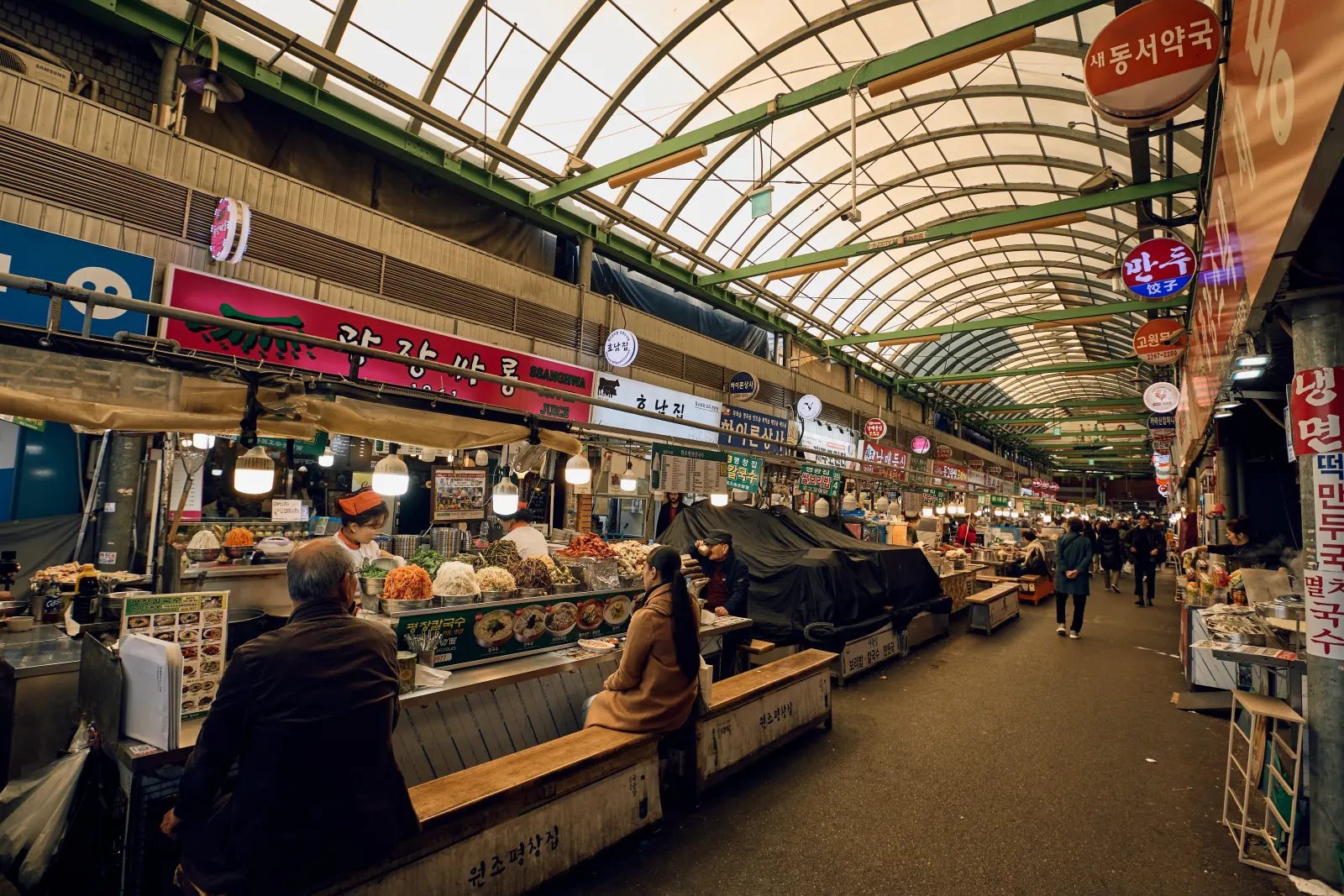
If you want to sample several dishes in one meal, Gwangjang Market in Jongno is the easy pick. It’s right outside exit 7 or 8 of Jongno 5-ga Station on Line 1. You usually sit side by side with strangers on the long benches in front of the stalls, and you can order just by pointing (per Seoul Tourism).
For first-time market navigators (Gwangjang food itinerary), classic street staples like mayak gimbap (mini seaweed rolls), tteokbokki, crisp bindaetteok (mung bean pancake), and steamed mandu offer the safest introduction. Keep track of cash totals, as grazing between multiple stalls adds up quickly. Street snacks stay affordable: market price checks show fresh sugar-twisted donuts (kkwabaegi) at 1,000 won, honey hotteok at 2,000 won, and cheese hotteok at 3,000 won. Major food alleys offer very consistent quality across vendors (Gwangjang tasting reviews). In the covered butcher alley, local dining itineraries recommend seasoned raw beef (yukhoe, 21,000–23,000 won) and yukhoe bibimbap (11,000 won) over live octopus (sannakji) for a smoother entry into Korean delicacies.
Seoul Tourism’s guide says foreign cards may not work at the stalls, so bring a little cash. Seoul’s real-time city data shows weekday mornings are quiet, and it gets crowded from about 1 pm, after lunch. If you want to eat slowly and take photos, go in the morning.
For getting to the market by subway, read how to use a T-money card first, and if you’ll be hunting for restaurants, how to use Korean map apps saves a lot of wandering. You’ll find more on Korean culture in K-culture.
Frequently asked questions
What should I eat first in Korea?
Bibimbap, samgyetang and japchae are safe picks, since they're either not spicy or let you control the heat. With bibimbap you can ask for the gochujang (고추장, red chili paste) on the side and add as much as you like.
Are side dishes and water free in Korean restaurants?
Yes. Water and side dishes (banchan, 반찬) are free, and you can ask for more (per the Korea Tourism Organization). Many restaurants now have a self-service corner where you grab water and side dishes yourself.
Do you tip in Korean restaurants?
No. Both the Korea Tourism Organization and the Seoul Tourism Organization say Korea has no tipping culture.
Do I have to order two servings if I'm eating alone?
There's no law about it, but some places, such as barbecue restaurants and jjimdak (braised chicken) shops, won't take an order for fewer than two servings. If you're alone, dishes that come as a single serving, like bibimbap, gukbap, gimbap or kalguksu, are the easy choice.
Can I check for allergens on a Korean menu?
Usually not at ordinary restaurants. Since 2017, allergy labeling has been mandatory only for franchises with more than 100 outlets that sell children's favorite foods, such as hamburgers, pizza, bakery goods and ice cream. Everywhere else, ask the staff directly.
Sources
- 한식메뉴 외국어 표기법 길라잡이 800선, 한식진흥원(농림축산식품부, 문화체육관광부, 국립국어원, 한국관광공사, 농촌진흥청 공동) (accessed )
- About Korean Food, 한국관광공사 (accessed )
- 韓国料理について(일본어 안내), 한국관광공사 (accessed )
- Tips for Vegetarians, 한국관광공사 (accessed )
- Muslim Friendly Korea, 한국관광공사 (accessed )
- Etiquette, 서울관광재단 Visit Seoul (accessed )
- Seoul’s Halal Restaurants Recommended by the City’s Muslim Residents, 서울관광재단 Visit Seoul (accessed )
- Solo diner mistreatment leads Yeosu restaurant to apologize(2025.7.21), 코리아타임스 (accessed )
- 어린이 기호식품 프랜차이즈 알레르기 유발 식품 표시 의무화(2017.5.30), 시대(식품의약품안전처 발표 인용) (accessed )
- KTO partners with Catch Table in effort to demystify Korean menus, 코리아중앙데일리 (accessed )
- Mild Korean food, HANISEOUL (accessed )
- Gwangjang Market food guide, Seoul Tourism (accessed )
- 중국인 친구들과 성수 고깃집 후기(2026.10.12), 네이버 블로그 dunchoni님의 블로그 (accessed )
- 이태원 누리마을감자탕 후기(2026.10.12), 네이버 블로그 큐밍 (accessed )
- 광장시장 먹거리 후기(2026.9.21), 네이버 블로그 우기 여행 맛집 블로그 (accessed )
- 외국인 친구와 광장시장 코스(2026.10.18), 네이버 블로그 오구룽의 Record On. (accessed )
- 서울 실시간 도시데이터(광장(전통)시장), FormThrow 기록, 서울특별시 서울 열린데이터광장 (accessed )
- 군산 육회비빔밥(한국관광공사 사진갤러리), 한국관광공사, 공공누리 제1유형 (accessed )
- 광장시장(필드), 세종학당재단, 공공누리 제1유형 (accessed )
- Gwangjang Market: What I'd Eat in Seoul's Oldest Traditional Market As a First-Time Visitor, Treksplorer (English travel blog) (accessed )
- Gwangjang Market must-try foods (2024.8.23), middleclass.sg (Singapore English-language blog) (accessed )
- Korean BBQ in Seoul for First-Timers: How It Actually Works (2026.7.18), Seoul With Me (English travel blog) (accessed )
- 8 useful tips for eating at a Korean restaurant for the first time (2025.4.23), GoGoHanguk (English-language blog) (accessed )
- 1330 Korea Travel Hotline, The Seoul Guide (describes the hotline run by the Korea Tourism Organization) (accessed )